Can a House Representative Be Registered as Independent
By voting at elections for the House of Representatives the people of each balloter sectionalization (also called an electorate or a constituency) select a person to correspond them in the Business firm. By selecting their representatives the voters, or electors, indirectly select the nation'southward government, because the government is formed from the political party or brotherhood of parties (coalition) which has a bulk (or the support of a majority) of the Members of the House of Representatives.
When are elections held?
Under Australia's Constitution each Business firm of Representatives may concluding no more than than three years from the first coming together of the Firm later an ballot, merely may be dissolved sooner. General elections are and so held to elect all Members of the Business firm of Representatives, co-ordinate to the timetable below.
If a seat in the Firm becomes vacant betwixt general elections, for example, if a Fellow member resigns or dies, a by-election is held to elect a new Fellow member to represent that electorate until the adjacent general ballot.
Who can stand for election?
Candidates for election must exist Australian citizens and be eligible to vote. Senators, Members of State Parliaments, public servants, including defence personnel, and officers of the Balloter Commission are not eligible to get Members of the Business firm of Representatives and must resign their position if they wish to nominate for election to the House. Some public service bodies have arrangements to allow unsuccessful candidates to rejoin the public service after the election. People who are citizens of, or concur fidelity to, a foreign country; who are undischarged bankrupts; or who have been bedevilled of certain offences are as well not eligible to go Members.
Candidates must be nominated past a political political party or by at least 100 electors of the electorate to exist contested. Still, a sitting Fellow member who was elected equally an independent needs nomination by only one elector, if they wish to stand up again for the same seat. On nomination candidates pay a deposit of $2,000. This is returned if the candidate is elected or receives at least 4 per cent of the (first preference) votes bandage in the electorate.
Who votes?
Australian citizens who are 18 years of age or older are required to enrol as voters unless they are non eligible considering, for instance, they are of 'an unsound mind' or serving a sentence of imprisonment of three years or more. Voting is compulsory for all people enrolled. People who exercise not vote may be fined.
Who conducts the election?
The Australian Electoral Commission, a statutory authority headed past the Electoral Commissioner, is responsible for the administration of all Commonwealth balloter matters including, for instance, the behave of elections, the maintenance of up to engagement lists of electors (electoral rolls) and the drawing of electorate boundaries. An election takes place in response to a formal order (writ) from the Governor-General (or the Speaker in the case of a by-ballot) requiring the Electoral Commissioner to conduct an election. For a general election a unmarried writ is issued for each state and territory.
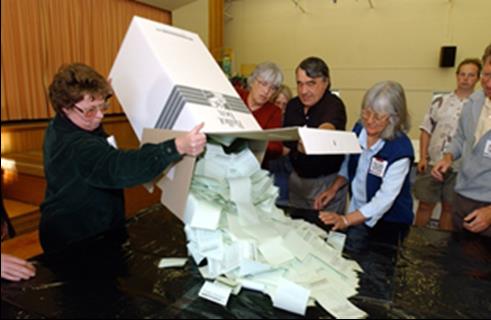
AEC staff counting the votes on an election day
Voting
The ballot paper for each electoral partition lists candidates' names and shows the parties they represent (if they do non represent a party, candidates may request to be shown as an 'Independent'). Candidates are listed in a random order, determined by drawing lots.
The arrangement of voting used in elections for the House of Representatives is preferential, that is, voters have to rank all candidates in order of preference—they may non just vote for one candidate. Voters are directed to marking their vote on the ballot newspaper by placing numbers in the squares reverse the names of the candidates so every bit to betoken their order of preference, for example, if at that place are three candidates, by writing the numbers ane, 2 and iii in the advisable squares. Election papers which are incorrectly filled out (breezy) are not valid and are not included in the count.
Preferential voting is designed to produce the election of the candidate who is most representative of the wishes of an electorate. To be successful a candidate must be supported by the majority (that is, more than than one-half) of voters. This system is considered fairer than a non-preferential (first-past-the-post) system under which the candidate with the most votes is elected, even though he or she may have support from less than half the voters.
The result—declaration of the poll and return of the writs
The result of each election is announced (declared) as presently as possible subsequently counting has been completed in the balloter sectionalization. Following a general election, when the results for all divisions take been declared the Balloter Commissioner certifies on each writ the name of the successful candidate for each division and returns the writs to the Governor-Full general, who in turn forwards them to the Clerk of the House of Representatives.
The validity of an ballot may exist challenged by a petition addressed to the Court of Disputed Returns (the High Court acting in a special capacity). This may occur if it is declared that a candidate was not eligible to become a Member for one of the reasons listed earlier in this infosheet or if it is claimed that there has been some irregularity in the election procedure.
Disclosure of income and expenditure, public funding
All candidates are required to make returns to the Electoral Commission detailing any donations they accept received for electoral purposes and electoral expenditure they have incurred or authorised. Political parties also take to submit annual returns or copies of their audited accounts. Disclosure laws as well apply to other people involved in the balloter process. This information is publicly available on the Electoral Commission website.
Candidates who receive at least four per cent of the (first preference) vote are reimbursed for balloter expenses by a specified amount for each such vote they receive. Ballot funding is paid either to a registered political party on behalf of each endorsed candidate or is paid direct to a candidate who is not endorsed past a registered party. This amount (which was approximately $ii.75 per vote for the election held on 18 May 2019) is indexed for inflation.

Electoral divisions
Australia is currently divided into 151 electoral divisions, each represented by 1 Member. Under the Constitution each existing state is guaranteed at least five Members, but all states except Tasmania at present have more, the numbers depending on their population. States may proceeds or lose Members every bit a consequence of population movements. Considering of Commonwealth of australia'southward uneven distribution of population, balloter divisions differ greatly in area, ranging from 32 sq. km (Grayndler, NSW) to over 1.half dozen million sq. km (Durack, WA). At June 2019, there was an average of approximately 109,718 electors per electorate.
Electoral boundaries are reviewed regularly and, if necessary, adapted (redistributed) to reflect population changes. The aim of redistribution is to ensure that electoral divisions within each state or territory contain approximately an equal number of electors. The last redistribution occurred on 31 August 2017, resulting in an increment in the number of electorates from 150 to 151 at the 2022 full general election (with the Human activity gaining the new seat). The number of balloter divisions in each of u.s. and territories is below:
| New Southward Wales | 47 |
| Victoria | 38 |
| Queensland | xxx |
| Western Australia | 16 |
| South Commonwealth of australia | 10 |
| Tasmania | 5 |
| Australian Capital letter Territory | 3 |
| Northern Territory | 2 |
| TOTAL | 151 |
When is the next general election?
The concluding possible appointment for the next election is within 68 days from the decease of the Firm. Every bit the 46th Parliament start met on Tuesday two July 2019, it is due to expire on Friday i July 2022. The next election for the Firm of Representatives must therefore be held past 3 September 2022, the last Saturday inside the 68 mean solar day menstruum. Notwithstanding, an election may be held at any time before that date.
As Firm of Representatives and half-Senate elections are unremarkably held simultaneously, the earliest date for such an election would be Saturday 7 August 2021.
Every bit the latest possible appointment for a half-Senate ballot is Sat 21 May 2022, the latest possible appointment for a simultaneous (half-Senate and Firm of Representatives) election is also Saturday 21 May 2022.
For more data
Firm of Representatives Practice , seventh edn, Department of the Firm of Representatives, Canberra, 2018,
pp. 85–106.
Australian Balloter Commission website: www.aec.gov.au
Image courtesy of Arthur Mostead, AEC.
Timetable for general elections

Source: https://www.aph.gov.au/About_Parliament/House_of_Representatives/Powers_practice_and_procedure/00_-_Infosheets/Infosheet_8_-_Elections_for_the_House_of_Representatives
0 Response to "Can a House Representative Be Registered as Independent"
Post a Comment